I am learning flutter from JustAcademy, They provide very much great environment where people gather and work simultaneously. totally project based training institute.
MOHD ABU BAKAR ANSARI
Flutter Developer
Awesome Experience. I am a Front-end Web Designer working at Star India for 3 years now. I applied for Full-stack development and my experience has been phenomenal & they really do help with placements exceptionally. Thank you Roshan sir so much.
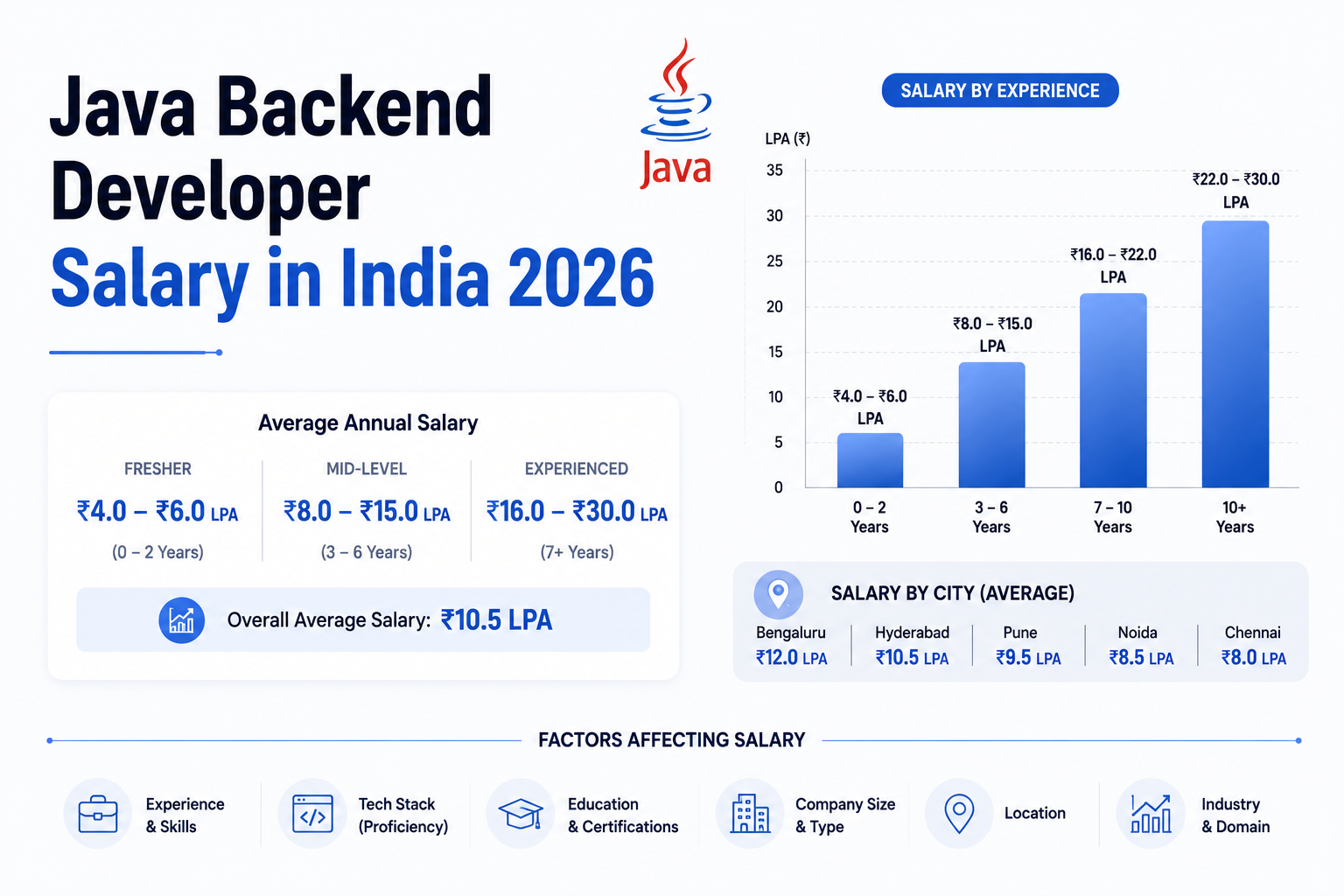
Java backend development continues to be one of the most stable and well-compensated technical career paths in India in 2026. Across banking, fintech, e-commerce, healthcare technology, IT services, and enterprise software, Java backend developers command salaries that reflect both the strategic importance of the systems they build and the consistent scarcity of genuinely skilled practitioners at the mid and senior levels. Understanding exactly what java backend developer salary ranges look like in 2026, what drives the differences between the lower and upper ends of each range, and what investments produce the most significant salary improvements is essential information for every Java developer making career decisions this year.
This blog provides a comprehensive, data-informed picture of the average java backend developer salary in india in 2026. It covers salary ranges by experience level, city, industry, and technology specialization, explains what drives salary growth at each career stage, and provides actionable guidance on how to position yourself at the higher end of the range appropriate for your experience. Whether you are a fresher evaluating whether Java is worth learning, a junior developer preparing for your first salary negotiation, or a senior engineer considering lateral moves or skills investments, this guide gives you the context and specifics you need.
Why Java Backend Developer Salaries Remain Strong in India in 2026
Demand Consistently Outpaces Supply at Mid and Senior Levels
The Indian technology job market in 2026 has an unusual characteristic for Java backend developers. At the entry level, there is no shortage of candidates who claim Java skills. At the mid and senior levels, there is a consistent and pronounced shortage of developers with genuine Spring Boot expertise, microservices architecture knowledge, and the ability to design, build, and troubleshoot complex enterprise Java systems. This supply-demand imbalance at the level where companies actually need developers to deliver independently is the primary driver of Java's strong salary position.
Companies competing for the same pool of experienced Java developers routinely offer compensation above market average to attract candidates from competitors. Senior Java developers with five or more years of production Spring Boot and microservices experience regularly receive multiple simultaneous offers, giving them significant negotiating leverage. This dynamic produces salary growth trajectories for Java developers that outpace many comparable technical roles.
Java runs the core banking systems of virtually every major Indian bank. It powers the payment processing infrastructure that handles hundreds of millions of transactions daily. It underlies the insurance policy administration platforms of the country's largest insurers. It operates the logistics management systems of India's fastest-growing e-commerce companies. And it forms the backend of the enterprise resource planning, HR management, and business intelligence platforms that large Indian corporations depend on for daily operations.
This mission-critical positioning means that companies cannot afford to have inadequate Java backend capability. They pay competitively because the alternative, inadequate systems failing in production at critical moments, carries consequences that dwarf the cost of competitive compensation. Java backend developers who work in these domains and who demonstrate genuine expertise in building reliable, high-performance enterprise systems benefit directly from this organizational priority.
Spring Boot and Microservices Expertise Commands Significant Premium
The evolution of enterprise Java architecture toward Spring Boot microservices deployed on cloud platforms has created a specific subset of Java backend skills that command salaries well above the average Java developer. Developers who combine deep Spring Boot expertise with Spring Cloud microservices patterns, Docker and Kubernetes deployment, cloud platform familiarity, and production performance optimization experience are in the highest demand and least supply segment of the market. The premium for this skill combination over baseline Java proficiency ranges from 25 to 50 percent depending on experience level and industry.
Java Backend Developer Salary by Experience Level in India
Fresher Java Backend Developer Salary (0 to 1 Year)
Freshers entering the Java backend developer market in 2026 face a bifurcated salary landscape. The lower end of the range reflects candidates hired by IT services companies through campus placements with basic Java knowledge. The upper end reflects candidates who have built genuine Spring Boot and JPA project experience before entering the market and are hired by product companies and banking technology firms.
Profile
Salary Range
Fresher with Core Java only
3 to 4.5 LPA
Fresher with Spring Boot basics
4 to 6 LPA
Fresher with Spring Boot, JPA, and REST APIs
5 to 7.5 LPA
Fresher with full stack Spring Boot and React portfolio
6 to 9 LPA
Fresher at product or fintech company
6 to 10 LPA
The salary premium for freshers who enter the market with genuine Spring Boot project experience rather than just Core Java knowledge is significant. Companies are willing to pay 40 to 60 percent more for a fresher who can contribute to a Spring Boot REST API from day one compared to one who needs to learn the framework on the job. This makes pre-placement training and portfolio building investments that pay returns from the first salary offer rather than over time.
IT services companies including TCS, Infosys, Wipro, and HCL typically offer fresher packages in the 3.5 to 5 LPA range through campus placements, with clear internal tracks for progression based on skill assessment performance. Product companies and banking technology organizations offer 5 to 9 LPA for freshers with demonstrated project skills, representing the higher end of the entry-level market.
Junior Java Backend Developer Salary (1 to 3 Years)
The first two years of professional experience produce the most variable salary outcomes in any developer's career. Developers who spend this period working on challenging projects, expanding their Spring Boot knowledge into Spring Security, Spring Cloud, and microservices, and actively building skills that exceed their job requirements progress to the upper end of the junior range. Those who spend the period maintaining legacy code without growth stagnate at the lower end.
Experience and Skill Profile
Salary Range
1 year experience, IT services junior developer
5 to 8 LPA
1 to 2 years with Spring Boot and MySQL
6 to 10 LPA
2 years with Spring Boot, Security, and Microservices basics
8 to 13 LPA
2 to 3 years at product company with deployment experience
10 to 15 LPA
2 to 3 years at fintech or banking technology
10 to 16 LPA
The most impactful move for junior Java backend developers in the 1 to 3 year range is demonstrating Spring Security and basic microservices capability. Developers who add JWT authentication implementation, Spring Cloud service discovery, and Docker containerization to their Spring Boot CRUD skills typically see a salary jump of 30 to 50 percent compared to peers at the same experience level who have only continued developing basic Spring Boot skills.
Mid-Level Java Backend Developer Salary (3 to 5 Years)
Mid-level is the most competitive and most rewarding experience band for Java backend developers. Companies have urgent and consistent demand for developers who can work independently, design non-trivial features, mentor junior developers, and contribute to architectural decisions. Supply at this level is genuinely constrained because producing a capable mid-level Java developer requires the combination of years of experience, deliberate skill development, and often multiple project contexts that many developers do not experience in a linear career.
Experience and Skill Profile
Salary Range
3 years, IT services senior developer
10 to 15 LPA
3 to 4 years with Spring Boot microservices
13 to 20 LPA
4 years with Spring Cloud, Docker, and Kubernetes
16 to 24 LPA
4 to 5 years at product company with cloud deployment
18 to 28 LPA
4 to 5 years with domain expertise in banking or fintech
18 to 30 LPA
At the mid-level, cloud platform experience produces the most significant individual salary premium. A developer with four years of Spring Boot experience without cloud exposure typically earns in the 13 to 18 LPA range. The same developer with hands-on AWS deployment experience, Kubernetes management, and CI/CD pipeline configuration earns 18 to 25 LPA for equivalent experience years. This premium directly reflects the operational maturity that cloud-experienced developers bring to production systems.
Senior Java Backend Developer Salary (5 to 8 Years)
Senior Java backend developers command salaries that reflect their ability to drive technical outcomes at the team and system level, not just their individual coding productivity. Companies at this hiring level are paying for architectural judgment, the ability to lead technical initiatives, mentoring capability, and domain expertise that prevents costly mistakes in system design.
Experience and Skill Profile
Salary Range
5 years, IT services tech lead
16 to 24 LPA
5 to 6 years at product company
22 to 32 LPA
6 years with microservices and cloud architecture
25 to 38 LPA
6 to 8 years at fintech or banking tech
28 to 42 LPA
7 to 8 years with architecture responsibility
32 to 48 LPA
Domain expertise becomes an increasingly significant salary multiplier at the senior level. A senior Java backend developer with strong Spring Boot skills and deep knowledge of financial services domain, including understanding of payment systems, regulatory requirements, credit risk models, and banking data architecture, is not competing in the same talent pool as a generalist senior Java developer. This domain-technical combination commands premiums of 20 to 40 percent above the generalist senior developer rate in banking and fintech organizations.
Principal and Architect Level Java Developer Salary (8 Plus Years)
Developers who progress to principal engineer, staff engineer, or solutions architect roles with Java specialization enter compensation territory that is driven by individual business impact rather than market rates. Base salaries are complemented by performance bonuses, employee stock options at larger organizations, and profit-sharing arrangements.
Role
Salary Range
Principal Java Engineer
40 to 60 LPA
Java Solutions Architect
45 to 70 LPA
Chief Architect or VP Engineering
65 to 1 Crore plus
Independent Java Consultant
Variable, 80 to 200 LPA equivalent
At this level, total compensation including bonuses and stock options can exceed base salary substantially at technology companies and funded startups with equity programs.
Java Backend Developer Salary by City Industry and Skills
Salary by City
Location remains one of the strongest determinants of absolute Java backend developer compensation in India. The concentration of specific industry types in each city creates different demand profiles and different salary norms.
City
Average Java Backend Developer Salary Range
Bangalore
8 to 35 LPA across all experience levels
Mumbai
7 to 38 LPA across all experience levels
Hyderabad
7 to 28 LPA across all experience levels
Pune
6.5 to 26 LPA across all experience levels
Delhi NCR
7 to 28 LPA across all experience levels
Chennai
6 to 24 LPA across all experience levels
Kolkata
5 to 18 LPA across all experience levels
Tier 2 Cities
4 to 15 LPA across all experience levels
Bangalore's concentration of product companies, global technology firms with India development centers, and funded startups produces the highest absolute Java developer salaries in the country. Mumbai's strong financial services sector creates particularly high compensation for Java developers with banking and fintech domain expertise, often matching Bangalore's product company rates for developers at the intersection of strong Spring Boot skills and financial domain knowledge.
Salary by Industry
The industry you work in significantly affects your Java backend developer salary ceiling and growth trajectory.
Industry
Typical Java Backend Salary Range
Product and Technology Companies
9 to 38 LPA
Banking and Financial Services
8 to 35 LPA
Fintech Startups
10 to 40 LPA
IT Services Large
5 to 28 LPA
IT Services Mid-Size
5 to 22 LPA
E-Commerce and Retail
8 to 30 LPA
Healthcare Technology
7 to 26 LPA
Consulting and Professional Services
8 to 30 LPA
Manufacturing Enterprise IT
6 to 20 LPA
Product companies and fintech startups offer the highest salary ceilings for Java developers because they compete most aggressively for talent and are most willing to pay above market for exceptional developers. IT services companies offer lower absolute salaries than product companies but provide structured career paths, exposure to diverse client projects, and the stability of large organizations that some developers value.
Salary by Technology Specialization
The specific technologies you master within the Java backend ecosystem have a direct and measurable impact on your salary positioning within any experience band.
Technology Skill
Salary Premium Over Average
Spring Boot with microservices
15 to 25 percent
Spring Cloud and service mesh
20 to 30 percent
Kubernetes and container orchestration
20 to 35 percent
AWS or Azure cloud deployment
20 to 30 percent
Kafka or RabbitMQ event streaming
15 to 25 percent
Redis caching and performance optimization
10 to 20 percent
Spring Security and OAuth2
12 to 20 percent
React or Angular full stack
15 to 25 percent
Domain expertise in banking or fintech
20 to 40 percent
These premiums are cumulative to a significant degree. A developer with Spring Boot microservices, Kubernetes, AWS, and banking domain expertise is not just adding these premiums together but is positioning in a highly specialized segment of the market where the competition for their profile is genuinely limited.
Total Compensation Beyond Base Salary
Base salary is only one component of total compensation for Java backend developers in 2026. Variable compensation including performance bonuses, which typically range from 10 to 20 percent of base salary at IT services companies and 20 to 50 percent at product companies, forms a significant additional component. Employee Stock Options at startups and publicly listed technology companies can represent substantial additional value for developers who join at the right growth stage and remain through vesting periods. Medical insurance, provident fund contributions, gratuity provisions, and remote work flexibility have monetary value that should be factored into compensation comparisons.
For senior developers and architects, retained equity in the form of RSUs at large technology companies is increasingly part of total compensation packages that bring effective annual compensation significantly above the base salary figures quoted here.
What Drives the Gap Between Lower and Upper End Salaries
The Demonstration Problem
The most common reason Java backend developers earn at the lower end of their experience band's salary range is the inability to demonstrate their skills convincingly during hiring processes. Developers who can point to a GitHub repository of production-quality Spring Boot applications, describe the architectural decisions they made in specific projects, explain the performance optimizations they implemented, and discuss the security configurations they designed are treated as quantitatively different from developers with the same experience years who can only speak generally about what they have worked on.
Building a portfolio of real projects, maintaining a professional GitHub profile, and practicing the articulation of technical decisions for interview contexts is as important as the skills themselves when positioning for the upper end of the salary range.
The Impact of Employer Type on Career Trajectory
Many Java developers spend their entire careers at IT services companies and plateau at salaries significantly below what their peers at product companies earn for equivalent skills. The structural reasons include that IT services companies maintain standardized salary bands with limited flexibility for individual negotiation, that the nature of services work does not always expose developers to the breadth of architectural challenges that product development does, and that the career track in services often moves toward management earlier than individual technical contributors might prefer.
Transitioning from IT services to product companies or fintech organizations, even with a lateral or slightly reduced immediate role level, frequently accelerates career trajectory and produces higher cumulative earnings over a five-year period than remaining in services at a similar level. Understanding this dynamics and making deliberate career moves rather than optimizing only for immediate salary increments is a strategic choice that significantly affects long-term compensation outcomes.
The Negotiation Gap
Research consistently shows that Java developers who negotiate their salary offers receive significantly higher compensation than those who accept the first offer. Negotiation backed by market data from platforms like Glassdoor, AmbitionBox, and LinkedIn Salary Insights is significantly more effective than negotiation based on desire alone. Knowing the range for your experience level in your target city and industry, understanding which skills command premiums in the specific role you are accepting, and being prepared to articulate why your specific combination of skills and experience positions you at the upper end of the range rather than the average are the components of effective salary negotiation.
How to Maximize Your Java Backend Developer Salary With the Best Training in 2026
The Investments That Produce the Highest Salary Returns
For freshers, the highest-return investment before entering the job market is building genuine Spring Boot project experience with REST APIs, Spring Data JPA, Spring Security with JWT, and MySQL before applying for roles. This portfolio investment costs time and training fees but produces starting salary offers 40 to 60 percent higher than offers received without it.
For junior developers at the 1 to 3 year stage, the highest-return skill investment is adding microservices capability through Spring Cloud alongside basic Docker and cloud deployment knowledge. This combination moves developers from the junior to mid-level compensation range 12 to 18 months earlier than developers who continue accumulating experience without deliberate skill expansion.
For mid-level developers, the highest-return investments are cloud architecture depth, Kubernetes proficiency, and domain expertise in high-value industries. These three areas produce salary premiums that compound on each other and position developers for the principal and architect roles that represent the highest compensation tier.
Why Structured Training Accelerates Salary Growth
The skills that produce the largest salary premiums, specifically Spring Cloud microservices, Kubernetes, cloud deployment, and production performance optimization, are genuinely difficult to develop through self-directed learning because they require infrastructure that is expensive to set up independently and problem contexts that only arise in production environments. Structured training programs that provide guided access to these technologies, real project scenarios that mimic production challenges, and instructor expertise in both the technical content and the interview presentation of that content produce skill development that translates directly to salary-changing capabilities.
JustAcademy's Java training programs are built around the complete Java backend skill set that produces the salary premiums described throughout this blog. The curriculum progresses from Core Java foundations through Spring Boot, Spring Security, Spring Data JPA, microservices with Spring Cloud, Docker and Kubernetes deployment, and cloud platform deployment, with real enterprise project work at every stage.
For learners in Maharashtra who want the best Java training in Mumbai with classroom-based learning, live interactive sessions, and placement support connected to Mumbai's strong banking and technology Java job market, Core Java Training in Mumbai and Advance Java Training in Mumbai are the programs built for exactly that outcome.
For Java developers who want to strengthen the frontend and full stack dimensions of their profile to access the full stack developer salary premium, JustAcademy also offers:
Related Courses to Strengthen Your Java Backend Career Profile
Building skills adjacent to Java backend development opens additional salary pathways and strengthens your overall market position. Explore these programs at JustAcademy:
Java backend developer salaries in India in 2026 reward genuine skill, continuous learning, and strategic career decisions more than years of experience alone. Freshers with Spring Boot project portfolios earn 40 to 60 percent more than those with only Core Java knowledge. Mid-level developers who add cloud and Kubernetes skills earn 20 to 35 percent more than those who plateau at monolithic Spring Boot. Senior developers with domain expertise in banking and fintech earn 20 to 40 percent above generalist seniors with equivalent experience. And the developers who invest in becoming genuine microservices architects with cloud-native deployment expertise and production performance optimization experience position themselves in the highest demand, highest compensation segment of the market.
The most important insight from this salary analysis is that the gap between where you are and the next salary level is almost always a skills gap rather than an experience gap. Companies are not paying more for more years of similar work. They are paying more for expanded capabilities that enable more complex and higher-value contributions. Identifying which skill additions produce the largest salary step-ups at your current level and investing deliberately in building those skills is the most reliable path to faster compensation growth.
The most efficient way to build those skills is through structured training that provides expert instruction, real project experience, and placement support that connects your demonstrated capabilities to the employers and roles that pay what those capabilities are worth.
Register for a Free Demo to experience the Java backend curriculum firsthand and speak with an advisor about the skill investments that will have the greatest impact on your salary trajectory, or Download the Brochure to review full course details, batch schedules, and fees before you decide.
Why Java Backend Developer Salaries Remain Strong in India in 2026
Java Backend Developer Salary by Experience Level in India
Java Backend Developer Salary by City Industry and Skills
How to Maximize Your Java Backend Developer Salary With the Best Training in 2026
What Delhi learners and working developers can realistically earn at every stage, and the skills, stack choices and mentor led training that move the number
From your first notes app to a multi tenant SaaS build, here are the MERN stack projects Delhi learners can build with live interactive guidance and show with pride on a resume.
A practical, human guide for Delhi freshers and working professionals who want to walk into every technical, design and HR round with real confidence, backed by live interactive, instructor led and mentor led sessions.
A practical, honest guide to frontend developer skills, the roadmap that actually works, and how live instructor led and mentor led training can get you hired
A practical, no fluff guide to the front end developer skills Delhi employers test for, and how mentor led, live interactive training helps you build them.
A practical, example driven guide to ES6 JavaScript for learners in Delhi who want to write modern code, think like a developer and get job ready with live instructor led and mentor led training
From your first Angular app to real time dashboards, here is a practical, mentor backed list of angular projects for practice, with source code thinking, live interactive sessions and placement support.
Drop us a Query
+91 99871 84296
Available 24x7 for your queries
Want To Connect with us
🚀 Kickstart Your IT Career
with JustAcademy
Learn Industry-Focused Courses with Live Projects & Placement Assistance
Full Stack Java(Java, Spring Boot, Hibernate, REST API, React JS)
Data Analytics(Excel, SQL, Power BI, Python, Tableau)